Wednesday, May 24, 2006
Cotswold Water Park and beyond
Phil Hardwick and I travelled up to Cotswold Water Park yesterday, and were fortunate with the weather. We arrived at Swillbrook Lakes around 8:45am, and were soon onto a couple of singing garden warblers. Along the path may have been a nightingale singing very briefly but it was clear after a few minutes that nightingales were much more quiet than last year. Two weeks too late perhaps? Nevertheless, before too long I was on to a nightingale out in the open showing off its russet tail. Unfortunately, I couldn't put Phil onto it, but he wasn't too concerned as he'd had crippling views a couple of weeks earlier.
We continued on to pit 57. Clouds of damselflies appeared as we walked along. I've never seen anything like it. Good numbers of common terns were feeding out on the water, but no hobbys. We moved on, and travelled down the lane by pit 44. Parking at the bottom, revealed we could actually view pit 57 from the opposite side from where we'd been. Within a minute or two we were watching a hobby hawking along the bank and perching on the fence posts. We watched for over twenty munutes before the bird was joined by another. This second was clearly the female, being much bulkier in size. They flew together for several minutes. Out of the corner of my eye, I noticed a pale bird on the water in front if the newly erected houses. With the scopes up, we were watching a drake and duck red-crested pochards.
Satisfied with ticking the three targets, we moved on to Avebury for tree sparrows. They were a little difficult to track down, but we finally managed three birds around the disused animal sheds at the end of of the farm. Several nestboxes are actually erected inside these sheds. Whitethroats were all over the place too.
We rounded the day off with a visit to Goldcliff for high tide. A lone spoonbill was in front of the first platform along with a few avocets with young, little egrets, a flock of dunlin, knot and redshank. Ringed plovers and little ringed plovers were on the island. We battled against the wind to walk to the seawall for a quick seawatch. It was quiet, but a few 'commic' terns moved up channel and then we tracked a distant bird for over a minute. It was almost certainly a skua, and Phil saw glimpses of a pointed tail. Possibly an Arctic skua, but difficult to be sure given the distance.
Another good trip, with 6 ticks taking me to 189 for the year. I've also heard cuckoo, grasshopper warbler and tawny owl.
Last year's 202 is now in sight. I'm still to see crossbill, nightjar, puffin, kittiwake, ruff, green sandpiper, white-fronted goose, cuckoo, beared tit and bittern. All of which I should connect with later in the year. Add in a good Norfolk trip and some passage and autumn migrants and I should eventually post my best year total so far.

Porthcawl Seawatch, 20 May
News of a large European storm-petrel movement in the south west, along with several other species moving past Porthcawl with favourable winds, seemed a good opportunity to catch up a few of the more tricky species to get. With this in mind, I settled into the shelter on the seafront in Porthcawl at 5:30am.
The first half an hour was quiet, with just a few gulls out at sea. The first bird of note however, was a great northern diver just off-shore. I was then joined by Peter Lansdown just as the rain came in. After a few more minutes, I picked up the first storm-petrel. Tiny birds, that would easily be missed scanning with the binoculars. Then another and another. It was actually difficult to tell how many were moving through, as they were difficult to follow for any length of time battling against the wind and waves. I estimated that I saw at least 12 birds in total during the session.
An immature gannet appeared and then the first Manx shearwater at around 6:45am. As soon as these birds appeared things picked-up and we got a steady stream of birds, mostly Manxies in parties of 5-30 in size all moving west. Three adult gannets moved through and full summer plumage great northern diver. Next were two blue-phase fulmars.
Way out, I thought there may have been a small party of kittiwakes and terns but it was impossible to be sure. Another bird caught my eye for a few seconds. Again way out, but I was sure it was a skua of some sort.
I concluded the morning at around 8:00am as Dean Bolt took up station.
Monday, May 15, 2006
North Wales Tour, 6-7 May, 2006
We made good time, thanks to Dan's Llanidloes shortcut, and were watching distant ospreys before lunch. We watched both birds in flight briefly and the male perched-up alongside the nest. There is a nice set-up at Glaslyn. The hide looks out to the nest with Snowdon as the backdrop. The downside is that the nest must be at least a kilometre away, and even with x60 on the 'scope, decent views are difficult. Especially when there's a heat haze as we had. Nevertheless, seeing ospreys is great, and we were able to watch the female sitting on eggs via the large flat plasma screen in the RSPB office. I now know where my subscription is going!
News that a woodchat shrike was on the Great Orme, swayed us from going to Anglesey, especially since the long-staying American golden plover had disappeared. (Guess what turned up on Anglesey, after the weekend!). A thorough search of the site where the shrike was seen proved fruitless though.
On to the little RSPB reserve at Conwy. Jeff and I managed a couple of year ticks here - sedge warbler and reed warbler and we saw a nice whimbrel on the estuary. A short trip in the car, gave us views over some quiet pools away from the main reserve footpath. Another tick in the form of a drake garganey was our reward.
With the afternoon running out, we set off for our second main target of the trip, little terns at Gronant. Dan was a little nervous, as he was not 100% sure the terns would be there. He should not have worried, even though the large numbers had not arrived, we must have seen at least 25 little terns both in flight and on the beach just 30m or so from us. We even watched a couple of pairs using sand eels in courtship. I also managed to tick a couple of ringed plovers on the beach. Offhsore, was an immature gannet and a red-throated diver. Plenty of Sandwich terns were out to sea, and another large flock settled on the beach to the east.
Satisfied we'd got our birds, we headed off for our digs another hour or so drive into the countryside. Dan had fixed us up with a nice B&B, with the added bonus of a pub serving food and real ale just up the road. A couple of pints of Thwaites Lancaster Bomber ensured a decent night's sleep ... well a few hours anyway, as we were up again at 4:30am!
A crowd of around 25 assembled at 5:30am at the Llandegla Forest Centre for the half hour walk to the black grouse lek, for our second RSPB event of the weekend. Up through the forest we marched, making sure not to drop to the back and miss out on prime views when we got to the hide. Some hide though! An old lorry container, with a few small slots to peer though out onto the moor. Dan and Jeff settled inside, but I decided to move outside and finally got a decent spot to set up the 'scope. The lek was about 400m away, but sure enough the blackcocks were doing their stuff. Fantastic! We watched them for over an hour, strutting about on their lek. One bird was even perched in a small tree. A grasshopper warbler was also singing somewhere on the moor, and a male merlin whizzed through.
We returned on a different route through the forest. A few of us were struck by a strange call from high in the canopy. None of us a had heard it before, but one of the party suggested the only thing he could think of was long-eared owl. Given we were on private land and with an RSPB party, we decided not to pursue the bird. We'll never know, but it could have been this.
We returned to the B&B and was eating breakfast by 8:15am. With no news on BirdGuides we headed south, deciding to try for some western oak-wood specialities along the way. On the way, we stopped briefly at Welshpool, where there's a nice little gravel pit reserve just off the by-pass. A number of black-headed gulls were on nests, and we got great views of a reed warbler and drake ruddy duck just in front of the hide.
Next stop was Dyffryn Woods just down the road from Gigrin Farm in Rhayader. As Dan and I walked up the hill looking for birds, Jeff stopped off to take a leak. He was soon adding both male and female pied flycatcher to his p**s list. Jammy b*$@ard! Further up the slope we connected with 3-4 redstarts, including one pair. Overhead were buzzards, ravens and a couple of red kites. Dan and I were still in pursuit of the elusive pied flycatchers though. Dan picked out a garden warbler , which was added to our yearlist but still no pied flycatchers. With me and Jeff searching up the hill, Dan whistled, signalling he was onto a bird. He'd picked out the female pied flycatcher at the top of a tree. We all got views. Further down, we got a brief glimpse of the male in flight. We enjoyed our lunch on the small reserve and then headed south.
Llangorse Lake outside Brecon often has black terns on passage during spring. BirdGuides was showing lots of black terns in the UK, so Llangorse was an obvious place to visit. We arrived at the church and overlooked the lake. It was deathly quiet. Just a few hirundines and swifts feeding and collecting mud, a grey heron and the ubiquitous Canada geese.
We didn't stay long and decided to try Craig Cerrig Gleisiad for ring ouzel. On setting up just below the cliffs, we heard a faint calling. This persisted througout our stay, but the bird proved elusive. I got a brief glimpse of a male high-up and called for Dan, but it disappeared before he arrived. This was all in stark contrast to the previous week, here Jeff and I had good views of a very active and noisy male.
By now we were a little tired and decided to call it a day.
All in all, another great trip, connecting with our three targets - black grouse, osprey and little tern, plus a a handful of year ticks each.
Sunday, May 14, 2006
Whinchat 16th May, Craig Cerrig Gleisiad
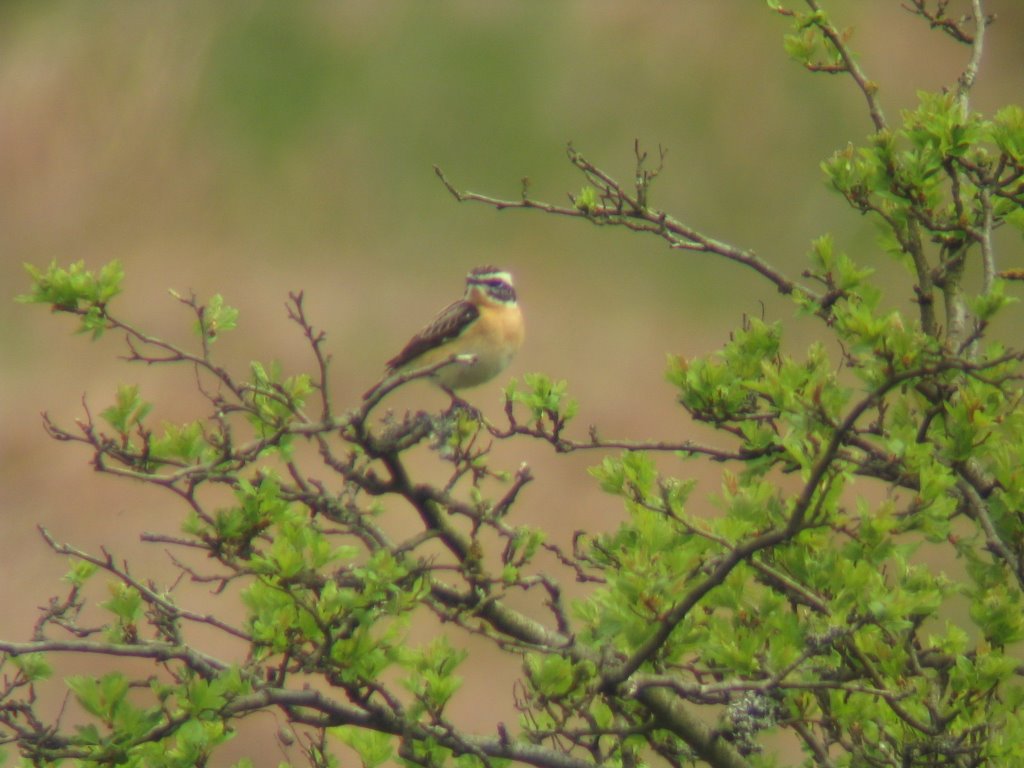
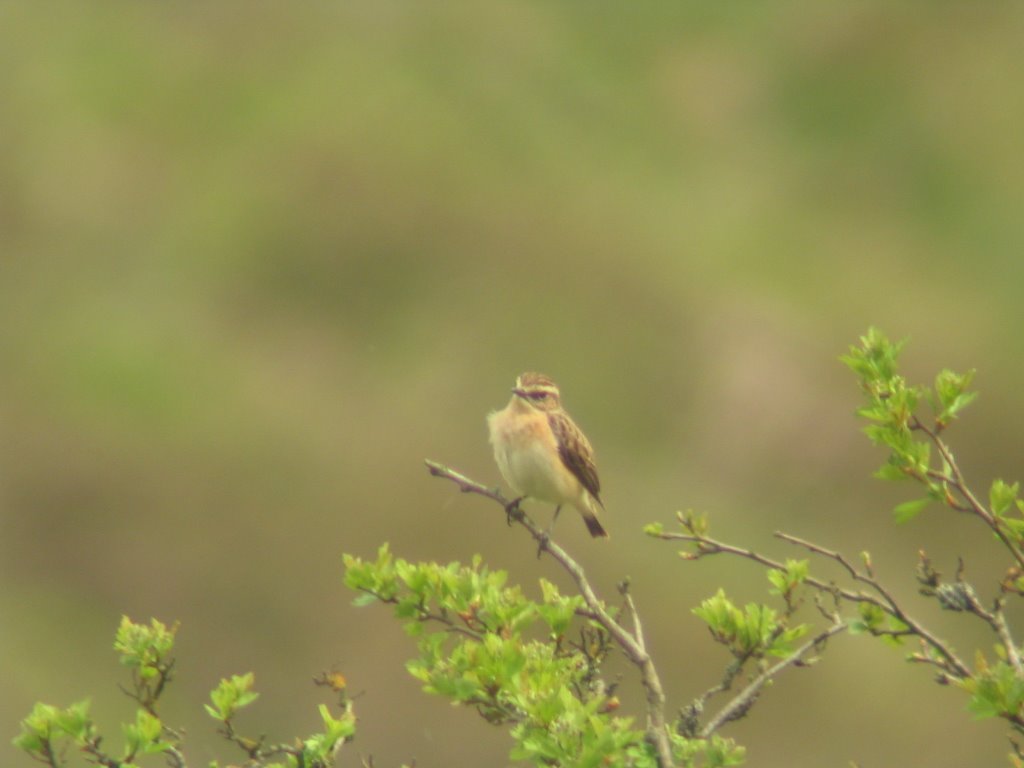 A cracking pair of Whinchats, below the steep slope where a Ring Ouzel called occasionally, and gave a brief glimpse. A Spotted Flycatcher was flitting around, and a few Redstart were seen.
The male Whinchat had an aerial tussle with a male Stonechat about 20 yards from us, and seemed to win, as the Stonechat retreated. A Tree Pipit was performing near the road.
A cracking pair of Whinchats, below the steep slope where a Ring Ouzel called occasionally, and gave a brief glimpse. A Spotted Flycatcher was flitting around, and a few Redstart were seen.
The male Whinchat had an aerial tussle with a male Stonechat about 20 yards from us, and seemed to win, as the Stonechat retreated. A Tree Pipit was performing near the road.
Monday, May 08, 2006
Redstart 7th May
 Showing and singing in a wood near Cardiff. Apparently 10 male Redstarts holding territory here. A pair of Pied Flycatchers were also present.
Subscribe to:
Posts (Atom)